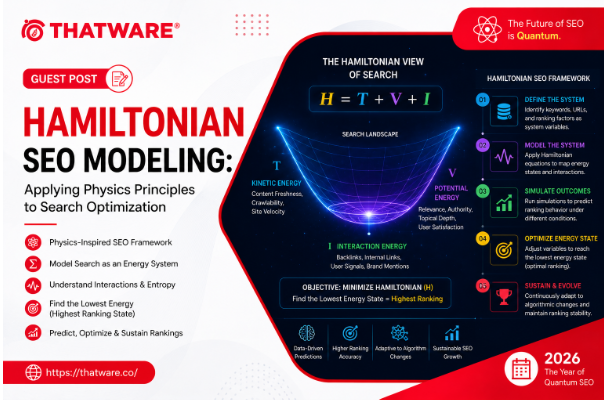
Physics and SEO don’t seem like obvious bedfellows. One is a rigorous mathematical science describing the fundamental behavior of matter and energy. The other is — depending on who you ask — either a strategic marketing discipline or an elaborate guessing game about what Google likes this week.
But there’s a genuinely interesting convergence happening, and it’s more than just analogical window dressing. Hamiltonian mechanics — a formulation of classical and quantum physics developed in the 19th century and now central to quantum computing — offers a mathematical framework that maps surprisingly well onto how modern search ranking systems actually process information. And understanding that mapping, even at a conceptual level, can change how you think about search optimization in useful, practical ways.
A Very Brief Introduction to Hamiltonian Mechanics
You don’t need a physics degree for this to make sense, but a bit of background helps.
In classical mechanics, we typically describe physical systems by tracking positions and velocities of objects. Hamiltonian mechanics reformulates this: instead of positions and velocities, it describes systems in terms of positions and momenta, operating in what’s called “phase space.”
The Hamiltonian function — H — represents the total energy of a system. The beautiful thing about Hamiltonian mechanics is that it describes how a system evolves over time entirely in terms of energy states and the relationships between variables. It’s particularly useful for complex, multi-variable systems where direct simulation would be computationally intractable.
In quantum mechanics, the Hamiltonian becomes an operator that governs how quantum states evolve. It’s central to Schrödinger’s equation, the foundation of quantum dynamics.
Now: why does any of this matter to someone trying to rank a website?
The Search Engine as a Hamiltonian System
Modern search ranking systems are extraordinarily complex. Google’s ranking infrastructure involves hundreds of signals, multiple neural network layers, real-time user behavior feedback, entity relationship graphs, and probabilistic intent models — all interacting simultaneously to produce a ranking result.
Trying to model this as a simple cause-and-effect system — “if I do X, I get ranking Y” — is like trying to predict the weather by looking at what it did yesterday. The relationships are non-linear, context-dependent, and constantly evolving.
Hamiltonian modeling offers a different approach. Instead of trying to map specific inputs to specific outputs, it models the energy landscape of the ranking system — the distribution of “states” your content can occupy and the forces that push it between them.
In this framing, your content’s ranking for any given query isn’t a fixed position. It’s a point in phase space — defined by a combination of relevance signals (semantic coverage, entity associations, user behavior signals, authority metrics) that collectively determine where in the ranking distribution your content sits.
The Hamiltonian SEO question becomes: how do we optimize the energy state of our content ecosystem to minimize the energy required to hold high-ranking positions across our target query space?
Practical Implications for SEO Strategy
This framing has genuinely useful practical implications, even for teams who have no interest in the underlying physics.
Stability over optimization — In Hamiltonian systems, low-energy states are stable states. Content that occupies a low-energy position in the ranking landscape — high semantic relevance, strong entity associations, comprehensive intent coverage — maintains its position with minimal ongoing intervention. Content that’s been optimized through high-energy tactics (aggressive link manipulation, thin keyword-stuffed pages) occupies high-energy, unstable states. A small perturbation (algorithm update) kicks it out of position.
Hamiltonian SEO modeling services focus on achieving and maintaining low-energy ranking states — building the kind of authentic topical authority that’s self-sustaining rather than requiring constant intervention to prop up.
Phase space mapping — Rather than targeting individual keywords, Hamiltonian-inspired SEO maps the full phase space of ranking opportunities in your domain. What are the dimensions that determine ranking state? How much coverage do you have across each dimension? Where are the low-energy (high-opportunity) positions that you’re not currently occupying?
Energy conservation — Content production resources are finite. Hamiltonian optimization asks: where is additional content production effort (energy input) most efficiently converted into ranking improvement (potential energy reduction)? This produces fundamentally different content priorities than simple search volume analysis.
Adiabatic Processes and Gentle Optimization
Here’s a physics concept that translates particularly cleanly into SEO strategy: adiabatic processes.
In physics, an adiabatic process is one that occurs slowly enough that the system remains in its lowest energy state throughout — evolving gradually without sudden jumps that disrupt system stability. In quantum computing, adiabatic quantum computation uses this principle to solve optimization problems by slowly transforming a system from a simple initial state to a complex final state.
In SEO terms, this maps onto a principle that experienced practitioners know intuitively but rarely frame this way: sustainable ranking improvements happen gradually and organically. Sudden, aggressive interventions — big link schemes, rapid keyword targeting pivots, mass content publishing — are non-adiabatic. They disrupt the system’s energy balance and often trigger corrections (algorithmic filters, ranking penalties, quality reviews).
Adiabatic Quantum SEO services apply this principle systematically. Rather than aggressive optimization campaigns, they build ranking position through gradual, continuous improvement — slow accumulation of topical authority, steady entity association strengthening, incremental semantic coverage expansion. The optimization path is designed to keep the system in a low-energy, stable state throughout, rather than seeking rapid jumps that create instability.
This is why Hamiltonian-inspired approaches tend to produce more algorithm-resilient results. The content is always moving through the energy landscape via adiabatic processes — smoothly, stably, without the sudden disruptions that trigger system corrections.
Applying the Framework: What Teams Actually Do
Translating Hamiltonian modeling from physics formalism into SEO practice requires a few specific analytical capabilities:
Energy landscape mapping — Analyzing your domain’s ranking environment to identify the topological features of the opportunity space. Where are the deep energy wells (high-authority positions that are well-defended and expensive to displace)? Where are the accessible low-energy positions (emerging topics, underserved semantic territories) where relatively modest investment produces significant ranking gains?
Phase space coverage analysis — Evaluating your current content ecosystem across the dimensions that determine ranking state: semantic breadth, entity depth, user intent alignment, technical health, authority distribution. Identifying gaps in phase space coverage.
Trajectory optimization — Planning content production and optimization sequences that move your site through the ranking phase space via adiabatic paths — gradual, stable improvement rather than aggressive jumps.
Energy conservation analysis — Allocating content production and optimization resources to the highest-efficiency opportunities — the moves that produce the most ranking improvement per unit of effort invested.
Why This Matters Beyond the Analogy
I want to be clear about something, because there’s a risk of this framework seeming like sophisticated-sounding window dressing on standard SEO advice.
The Hamiltonian model isn’t just a metaphor. It’s pointing at a real characteristic of search ranking systems — that they’re complex, multi-variable, non-linear systems that are better described by energy-state mathematics than by simple input-output relationships.
The practical upshot: SEO strategies built on Hamiltonian-inspired thinking will consistently outperform strategies built on classical optimization thinking, because they’re based on a more accurate model of how the ranking system actually works.
The teams and organizations that internalize this — that stop asking “what do I need to do to rank for this keyword” and start asking “what energy state does my content ecosystem need to occupy to be durably competitive across this topic space” — will find themselves building something that compounds over time rather than constantly scrambling to maintain position.
Physics principles applied to search optimization: strange pairing, real results.